




Acelab's Revit Plugin
connecting materials directly into architects’ Workflow.
Plug-in Design · Systems Design · Cross-Platform Workflows


Seamlessly connect material library to Revit
Architects love Acelab’s cloud library of 100k+ building materials, but their actual execution happens inside Autodesk Revit. Living purely on the web created a broken, error-prone ecosystem loop.
At Acelab we designed a Revit plugin that eliminated the double-entry workflow between Acelab and Revit — giving enterprise architecture firms a bidirectional, trusted connection between material specification and their live Autodesk model.
Shipped to AECOM, JLL, HOK, Sasaki.
6+
Enterprise firms Adopted:
AECOM, JLL, HOK, Sasaki and more..
2
Mapping directions.
Both first-class.
One modal.
$→
Became a premium paid feature. Direct revenue driver for Acelab.

Team & my role
PRODUCT
Web App Plugin
TIMELINE
Q1 2023 - Q4 2024
MY ROLE
As the Senior Product Designer, I owned the complete design lifecycle for every feature area within the Revit plugin. This was not a single-feature assignment — it required systems thinking across multiple interconnected workflows, coordinating with a cross-functional team, and balancing user needs against Revit API constraints.
User Research: Designed and deployed multiple Surveys (keynote sync preferences, navigation A/B testing, Revit asset management direction) and synthesized findings into actionable design directions.
Interaction & Systems Design: Designed the full plugin experience across seven feature areas, ensuring consistent patterns, shared components, and a coherent information architecture.
UX Writing: Authored all UI copy, error messaging, survey copy, and stakeholder communications for the plugin features.
TEAM
Hardik Makrubiya - Lead PM
Armaan Shah - CX
Juliana Zonotto - instructional Designer
Mayank Sharma - BE Dev
Bekele Debisa - FE Dev
E-Verse - Third-Party Revit Devs
SKILLS
Visual Design, Stakeholder Management, Interactive Prototype, User research, Focus Groups
IMPACT
Launched as an Enterprise Pro (paid) feature on Materials Hub due to high user adoption, and usage post release.
Platfrom State
The Problem, the quick TL;DR
Every architecture firm runs two tools. But they’ve never spoken to each other.

Acelab
Acelab is where architecture firms research and manage building products — everything from curtain wall systems to acoustic ceiling tiles.
It’s where material decisions live.
Autodesk Revit
Autodesk’s BIM (Building Information Modeling) software, used by nearly every major firm, where architects model, document, and coordinate.
It’s where the real work lives.


So what did architects do when they
needed information from both?
They did it manually.
Every time.
for every project.
Existing State
How material mapping works currently?
To design for this complex cross-platform ecosystem, we audited the existing material mapping workflows to understand how architects capture technical data in Autodesk Revit.
Here’s what a normal workflow looked like before the solution existed:

Breaking down the gaps in the workflow:
INUDSTRY Trend
BIM adoption is near-universal.
The tooling gap isn’t.
Source: Autodesk State of BIM Report, 2023
18%
73%
90%
Integrated Spec
BIM Mandate
Revit Useage
🏗️
90% of major AEC firms use Revit as their primary BIM tool
Yet fewer than 1 in 5 have any integrated spec or material workflow connected to it.
Time Cost
Manual data entry costs architects
up to 30% of their project time.
Source: McKinsey Global Institute, AEC Productivity Report
⏱️
The AEC industry loses an estimated $400B annually to poor data handoffs and rework.
Material specification — re-entered manually between tools — is one of the highest-friction points in the documentation workflow.
Slower design processes and higher coordination costs
WORK FLOW PATTERN
8 in 10 architects never fully close Revit during a project
Source: Acelab focus groups
Q. How do architects work currently?
79%
Switch tools regularly — 21%
Never close Revit mid-project 79%
No Revit-native bridge between Acelab’s API and Revit

What if…
Acelab didn’t just live on a browser tab — but inside the tool architects use every day?
That question became the brief. The answer became a Revit native plugin.

The real insight was that architects never fully leave Revit during a project. It’s their source of truth.
So, We built a native Revit plugin with three core capabilities each one built to eliminate a specific failure in the architects data sync workflow.
Solution
Acelab's plug-in
for Revit
What we solved for, using the Plug-In:

Architect is in control
Establish firm-wide materials in Acelab & map bidirectionally in Revit.
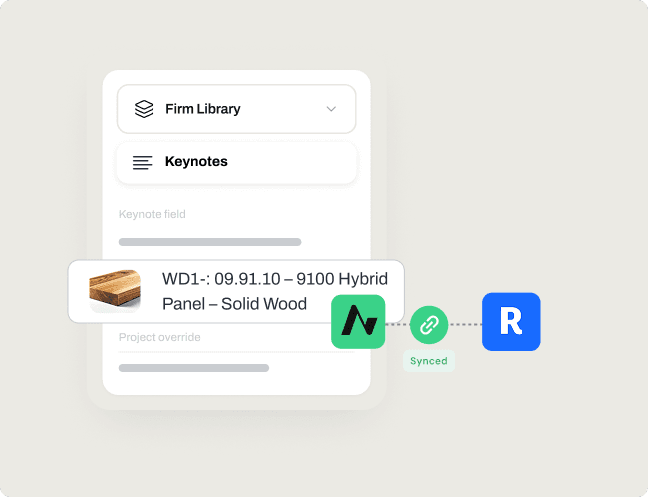
Keynotes Automation
Standardized keynote values sync bidirectionally with Revit.

Auto Syncing
Eliminates manual back-and-forth for keynote entry & cross-referencing.
Or keep scrolling to know the design process
Context & Background
About Acelab Material Hub
A materials intelligence platform for the construction industry. Where architecture firms research, evaluate, and manage building products — from early concept to final specification. 100k+ products, cloud-based, connecting spec to supply.

Architects &
Designers
From first search to final specification.

Owners & Developers
Material intelligence
through delivery

Manufacturers & Suppliers
Reach architects at the moment of decision
So, we needed to hear it what architects want?
We ran contextual inquiry sessions, 3 to 5 participants per session, recruited from firms with active Revit workflows and focus groups with architects and BIM managers across AECOM, JLL, HOK,
and Sasaki which are big firms, watching how they actually moved between tools during a project.
8/10
Said they never fully close Revit during an active project
9/10
Said Revit as their real source of truth not any web tool
10/10
Said they’d use a tool more if it lived inside Revit
Disjointed Context-Switching
Architects leave Revit to find materials
Jumping between browser tabs and the design environment breaks focus and slows down documentation.
Sync conflicts
Manual updates create version risk
A single mismatched parameter between a web collection and an active drawing can cascade into costly errors on site.
What focus groups helped us understand?
One-way data flow
The desktop file is the only source of truth
No path from web to model means users who prefer cloud-first workflows are stuck.
Keynote Constraints
File-based updates don’t scale
Manual keynote management breaks down during heavy documentation — model connections drop and data corrupts.
Hypothesis
We entered discovery with a hypothesis.
Architects want to push Acelab data into Revit faster.
What we found was different. The workflow wasn’t linear, and it wasn’t one direction.
BIM managers started from Revit. Architects started from Acelab. Neither was wrong. Both were primary. That single observation rewrote the brief.
Every request architects made pointed to something deeper than a missing feature.
Here’s what we heard and what it actually meant.
Ranked #1 · All Firms
Real-time sync
Confidence in data integrity
Sync = trust, not speed
Ranked #2 · HMC & COOKFOX
Bulk keynote assignment
Reduce repetitive work
The real cost is human time
Top 3 · All Firms
Spec integration
One authoritative source
“Doing the work once”
Unprompted · Beth
Rendering software
Workflow continuity
Don’t break their existing tools
Focus Group Findings:
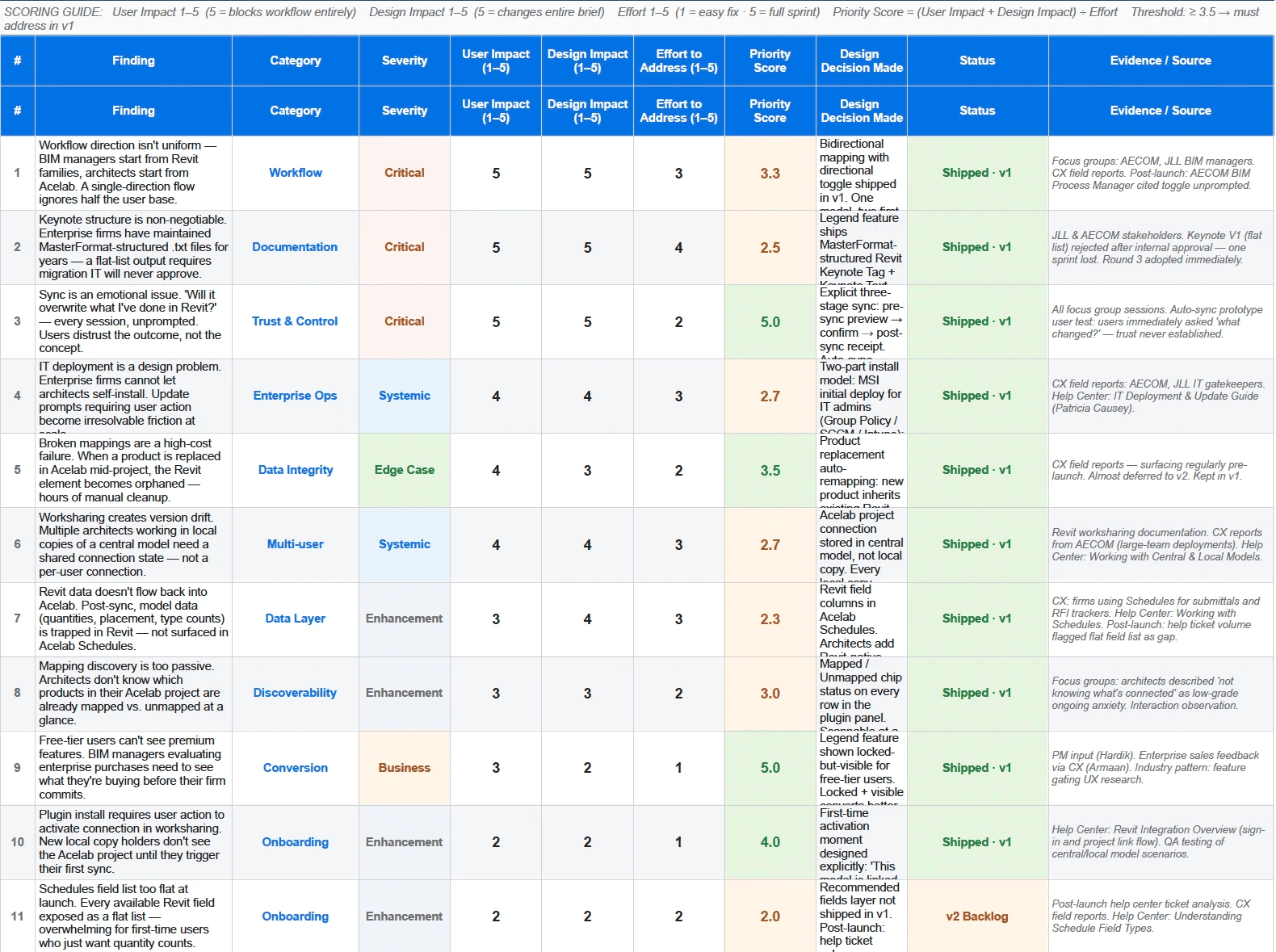
Each finding from the focus groups scored by user impact × design impact ÷ effort. Anything above 3.5 shipped in v1. We went through a detailed analysis of how this feature would evlove over time and detailed out
Exploring platform approaches
Before deciding what to build, we asked:
where should it live?
Coming out of the workflow audit and focus groups, the problem was clear — but the solution space wasn’t. We had three technically viable paths to connect Acelab and Revit.
We mapped them out, stress-tested each one, and took the questions again into focus groups before committing to any direction to validate our research.
01
REJECTED
CSV Import
Still manual. Creates a new version-drift problem on every export. Architects had already abandoned it.
PATH OF LEAST RESISTANCE
02
REJECTED
Web API Bridge
No in-Revit presence. Invisible to architects. Untrustworthy without visibility into what changed.
NO REVIT PRESENCE
03
SELECTED
Native Plugin
Lives where architects already work. Persistent. Bidirectional. Once embedded, switching cost is high.
ACELAB MOVES INTO THEIR SPACE
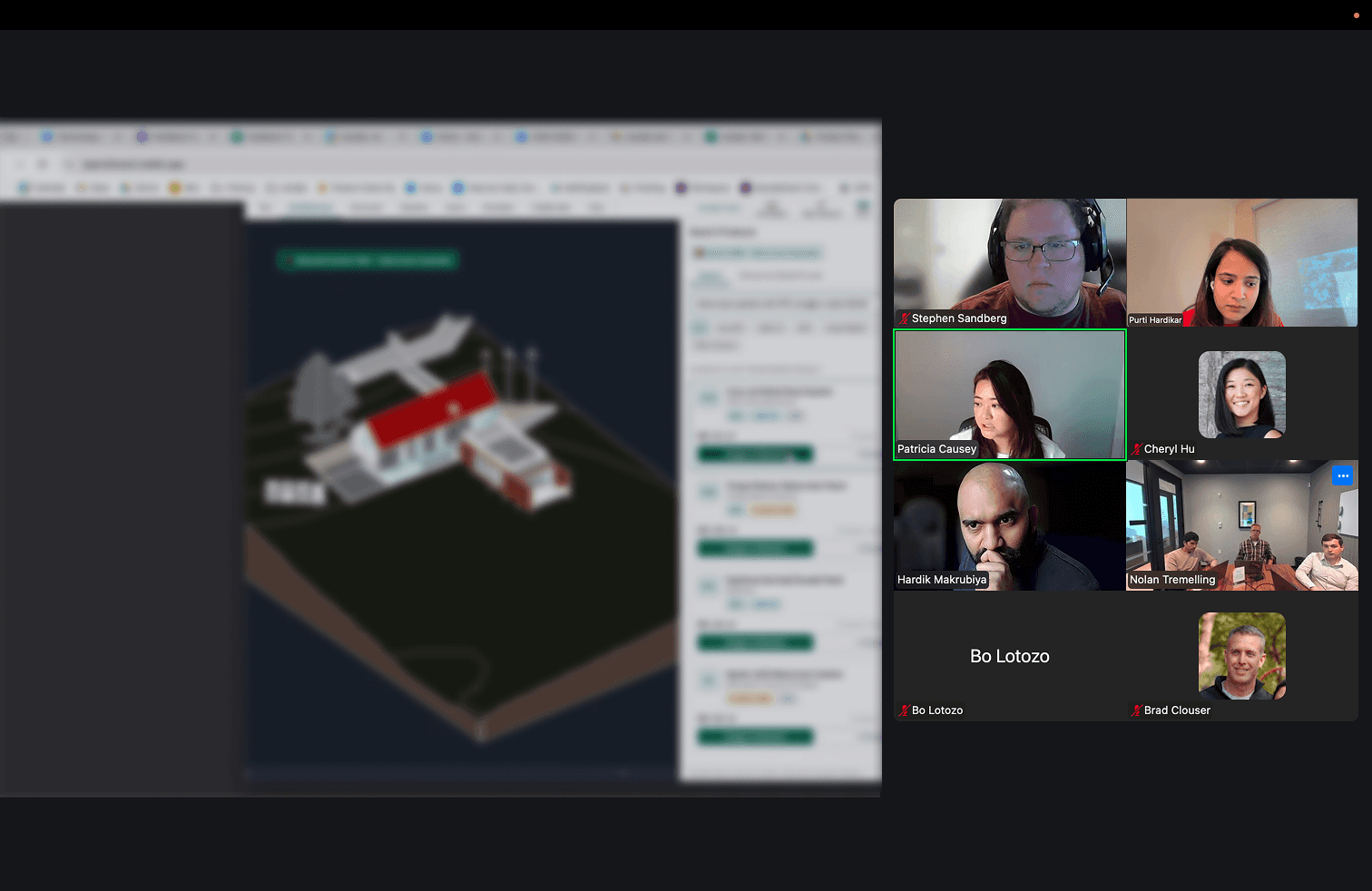
We prototypes and discussed various design options for the revit plug-in
What the plug in unlocks?
Before
Select in Acelab
Leave Revit
Re-enter manually
Product changes
Start over
After — The Plugin
Open Acelab panel
Map product
Confirm sync
Both tools updated
Done
Acelab moves into their space. The architect never leaves Revit.
Hand Off
Design Solutions: Seven Feature Areas
The plugin needed to display complex hierarchical data — Revit families, types, and materials — in a way that supported both browsing and targeted lookup.
The team was divided between a unified tree view and a tabbed approach, with valid arguments on both sides.
Starting from what we have
Connect Acelab Product to Revit Assets
THE CHALLENGE
The plugin needed to display complex hierarchical data — Revit families, types, and materials — in a way that supported both browsing and targeted lookup.
The team was divided between a unified tree view and a tabbed approach, with valid arguments on both sides.
MY APPROACH
Rather than rely on internal opinions, I designed an A/B preference survey that presented both options to real users with visual examples, then asked about scanning speed, workflow frequency, and specific concerns with each approach.
View of the super-admin dashboard with editing access
View of the super-admin dashboard with editing access
DESIGN GOAL: FUNCTIONAL | Super Admin
Connect Acelab Product to Revit Assets
THE CHALLENGE
The plugin needed to display complex hierarchical data — Revit families, types, and materials — in a way that supported both browsing and targeted lookup.
MY APPROACH
Rather than rely on internal opinions, I designed an A/B preference survey that presented both options to real users with visual examples, then asked about scanning speed, workflow frequency, and specific concerns with each approach.
Two Workflows, One Goal:
Survey-driven IA — chosen from user preference data, eliminating recurring disagreements.
Expand/collapse with scroll — family, type, and material shown together, expandable and scrollable.
DESIGN GOAL: FUNCTIONAL | Super Admin
Product Mapping
THE CHALLENGE
The plugin needed two distinct mapping capabilities — connecting Acelab catalog products to Revit model elements, and linking Revit materials/assets back to Acelab’s database. These functions needed to feel related but clearly differentiated, as they serve different directions of the data flow.
DESIGN DECISIONS
Dual mapping functions: I designed “Map Products” (Acelab → Revit) and “Map Revit Assets” (Revit → Acelab) as paired but distinct actions, each with clear naming and complementary iconography.
Both icons use the same geometric style but with directional cues — one representing outbound mapping, the other inbound — reinforcing the bidirectional nature of the integration.
Naming exploration: I tested alternatives like “Link Products,” “Connect Products,” “Sync Assets,” and “Connect Materials” before settling on names that most clearly communicated the action and direction.
View of the super-admin dashboard with editing access
Exisiting State
It shipped. It worked.
And then it changed
how Acelab was positioned.
6+
Enterprise firms Adopted:
AECOM, JLL, HOK, Sasaki and more..
2
Mapping directions. Both first-class.
One modal.
$→
Became a premium paid feature. Direct revenue driver for Acelab.
The plugin launched Q3 2025 as a premium paid feature.
AECOM, JLL, HOK, and Sasaki adopted at launch. But the bigger shift wasn’t the adoption numbers it was what the plugin meant for how Acelab described itself.